GRC and cybersecurity: master governance, risk, and compliance

Secure your IT assets effortlessly
Discover our all-in-one solution

A cyberattack costs more than just data. It costs time, trust, and sometimes regulatory fines. Yet, in many companies, IT security remains managed on an ad-hoc basis: an antivirus here, a password policy there, an audit when a client demands it.
Cybersecurity GRC offers a different approach. Governance, risk management, and compliance are managed together within a single framework aligned with business objectives. The result: clearer decision-making, better risk control, and regulatory compliance that is no longer handled in a state of emergency.
In this guide, we explain what GRC in cybersecurity is, why it is becoming essential in 2026 with NIS2, DORA, and GDPR, which tools to choose, and how to implement it step-by-step in your organization.
What is GRC in cybersecurity?
GRC—Governance, Risk, and Compliance—is an integrated approach that allows an organization to manage its information systems security in a structured way. Rather than treating each topic in isolation, it links management decisions, threat assessment, and regulatory compliance into a single logic. It is the foundation of a cybersecurity strategy for your company that is truly controlled, rather than reactive.
Defining governance, risk, and compliance
Governance refers to the set of rules, roles, and processes that frame security decision-making. It answers simple but structural questions: who decides, who is responsible, how priorities are set, and how management is kept informed.
Risk management involves identifying threats to the company, assessing their likelihood and impact, and then deciding how to handle them: by reducing, transferring, avoiding, or knowingly accepting them.
Compliance aims to ensure that the organization meets the legal, regulatory, and contractual requirements that apply to it, as well as its own internal policies. GDPR, NIS2, DORA, or ISO 27001 are the most common examples.
The three core pillars of GRC
The three pillars of GRC do not operate in silos. They feed into one another:
- Governance sets the course : it defines security objectives, the acceptable level of risk, and individual responsibilities.
- Risk management informs decision-making : it indicates where to focus efforts and budgets based on real threats.
- Compliance proves and controls : it verifies that rules are being followed and provides the evidence required by auditors, clients, and authorities.
When one of these pillars is missing, the whole structure weakens. Compliance without risk analysis becomes a box-ticking exercise. Risk management without governance leads to no decisions at all.
Difference between GRC and traditional security management
Traditional security management is often technical and reactive. It relies on the IT team to deploy tools and patch vulnerabilities as they arise. Security is viewed as an IT issue, rarely as a leadership priority.
The GRC approach shifts the perspective:
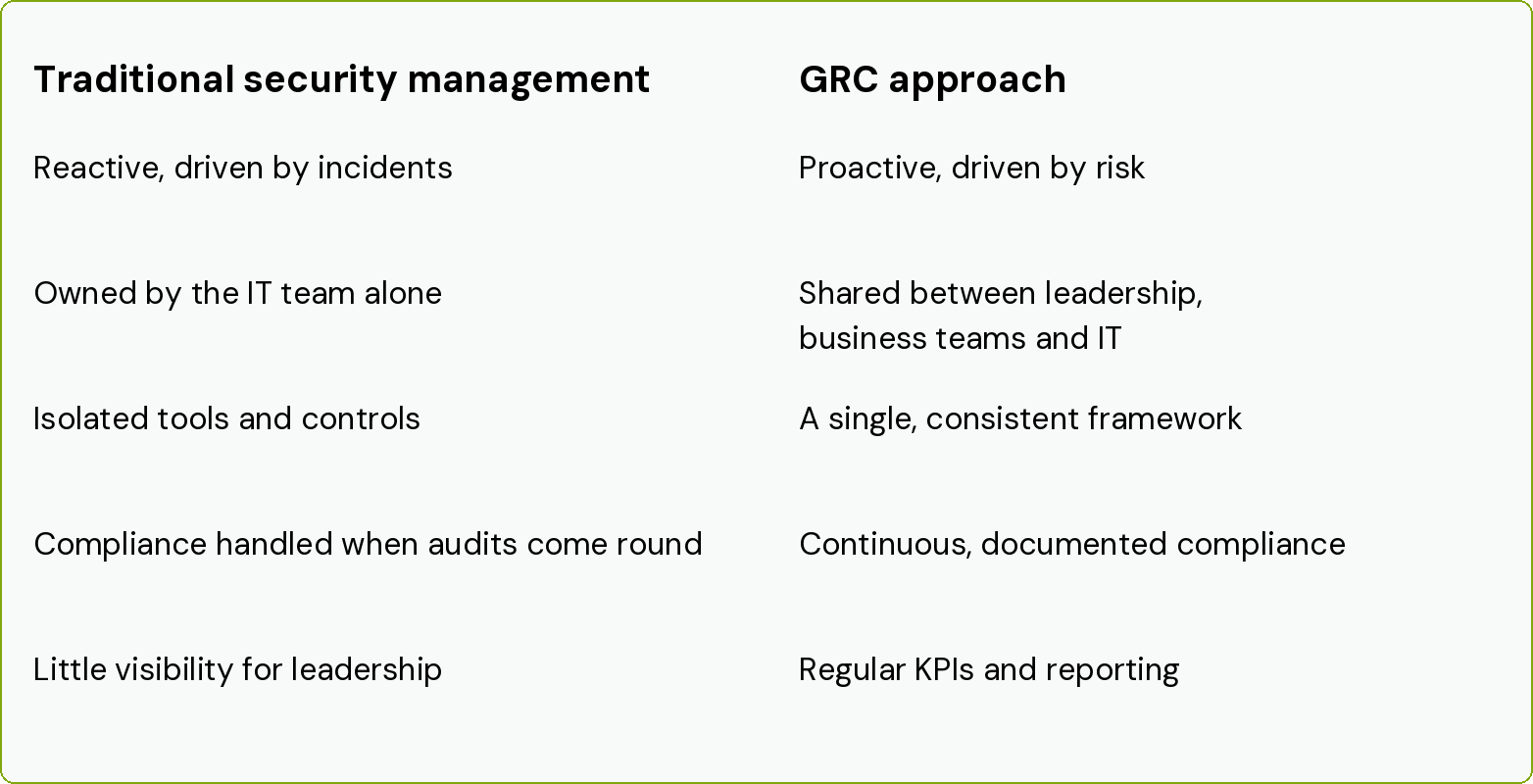
GRC does not replace technical security. It provides it with direction, priorities, and legitimacy at the corporate governance level.
Why implement a GRC strategy in your organization?
A GRC strategy is no longer reserved for large corporations or banks. With the rise of cyber threats, the tightening of the European regulatory framework, and increasing client demands, SMEs and mid-market companies are now on the front line.
Reducing cyber risks and protecting information systems
Ransomware, phishing, credential theft, and data leaks via unsecured workstations: threats are multiplying and increasingly targeting mid-sized organizations, which are often less well-protected.
A GRC approach allows you to move from "securing everything a little" to "securing what matters most first." By mapping critical assets (customer data, business tools, workstations, access) and assessing the associated risks, the company focuses its efforts where the impact would be greatest. Protecting information systems thus becomes rational, measurable, and defensible to management.
Ensuring regulatory compliance and avoiding penalties
The regulatory landscape has become significantly more complex:
- GDPR : personal data protection, with fines of up to 4% of annual global turnover.
- NIS2 : the European directive extends cybersecurity obligations to thousands of entities deemed essential or important, and directly holds executives accountable.
- DORA : a digital operational resilience framework for the financial sector and its IT service providers.
- ISO 27001 : a voluntary standard, but one increasingly required in tenders and by major accounts.
Without a GRC framework, every regulation is handled separately, leading to duplication, oversights, and a great deal of wasted energy. With a GRC framework, controls are centralized: a single control (such as access management) can simultaneously satisfy multiple requirements.
Optimizing IT governance and aligning security with business objectives
Too often, security is perceived as a hurdle: restrictive rules, slowed-down projects, and budgets that are difficult to justify. GRC reverses this logic by linking every security decision to a business objective.
In practical terms, this means that management makes decisions with full awareness, business units understand why certain rules exist, and the IT team has a clear mandate. Security becomes a driver for business continuity, commercial credibility, and growth, rather than a cost center.
The essential components of an effective GRC framework
An effective GRC framework is built on three operational pillars, each with its own roles, processes, and tools.
Governance: roles, responsibilities, and decision-making processes
Governance begins with one question: who is responsible for what? A GRC framework clarifies key roles:
- Executive management sets the risk appetite, validates the strategy, and holds ultimate responsibility (an explicit requirement of NIS2).
- The CISO or security lead drives the initiative, coordinates actions, and handles reporting.
- The IT department or IT provider implements technical measures and operates the systems.
- Business unit managers identify the critical assets for their operations and apply the rules on a daily basis.
- The DPOwhere applicable, ensures the protection of personal data.
These roles rely on formalized decision-making processes: a security committee that meets regularly, approval workflows for new tools, and escalation procedures in the event of an incident. In an SME, these roles may be combined or partially outsourced to a GRC consultant or an IT partner.
Risk management: identification, assessment, and treatment of threats
Risk management follows a four-step cycle:
- Identify assets (data, applications, equipment, accounts) and the threats targeting them.
- Assess each risk based on its probability and impact (financial, operational, legal, reputational).
- Treat priority risks: technical measures, procedures, cyber insurance, or formal acceptance.
- Monitor the evolution of risks in a regularly updated register.
Recognized methods such as EBIOS Risk Manager (supported by ANSSI) or ISO 27005 provide a proven framework for structuring this analysis. The key is to produce a living risk register that is understandable to management and used for decision-making.
Compliance: policies, controls, and regulatory audits
Compliance translates external requirements and internal decisions into applicable rules. It is structured around three elements:
- Security policies : information systems security policy (ISSP), IT charter, access management policy, business continuity plan.
- Controls : concrete measures that ensure policies are applied, such as workstation encryption, multi-factor authentication, backups, or periodic access rights reviews.
- Audits : regular internal or external verification that controls are working and that the organization remains compliant with applicable regulations.
Solid compliance must be documented. Evidence (logs, reports, inventories, review minutes) must be available at all times, not reconstructed in a rush the day before an audit.
The tangible benefits of a structured GRC approach
Beyond mere compliance, a GRC approach delivers tangible benefits for the company, its teams, and its partners.
Improved data protection and system integrity
By precisely identifying where sensitive data is located and who has access to it, GRC significantly reduces blind spots. Access rights are reviewed, inactive accounts are deleted, devices are encrypted, and backups are tested.
System integrity is strengthened as a result: changes are tracked, configurations are controlled, and discrepancies are detected earlier. One often overlooked aspect is the equipment lifecycle. A poorly configured computer when a new employee joins, or one that isn't wiped upon their departure, is a classic entry point. Integrating IT onboarding and offboarding into the GRC framework closes this door.
Reduction of costs related to security incidents
A security incident costs far more than just technical recovery: business interruption, loss of revenue, legal fees, notification of affected individuals, and reputational damage. For an SME, a ransomware attack can paralyze operations for several weeks.
GRC acts on two financial levers:
- Fewer incidents, thanks to preventive controls targeted at major risks.
- Less severe incidents, thanks to response and continuity plans prepared in advance.
It also allows for better spending: by prioritizing based on risk, the company avoids stacking redundant tools and invests where the return on security is highest.
Strengthening stakeholder trust
Clients, partners, investors, and insurers: all stakeholders are now interested in the security posture of those they work with. Security questionnaires are becoming more common in sales cycles, and cyber insurers now make their coverage conditional upon meeting minimum security measures.
An organization with a GRC framework can respond quickly and with evidence. It reassures its clients, shortens its sales cycles, negotiates better insurance terms, and demonstrates to its employees that the protection of their data is taken seriously. Trust becomes a competitive advantage.
GRC tools and software: how to choose the right solution?
A spreadsheet might be enough to get started, but it quickly reaches its limits: multiple versions, scattered evidence, and manual tracking. GRC software centralizes your risk register, policies, controls, and action plans, while automating part of the monitoring process.
Criteria for selecting a suitable GRC platform
Before choosing a GRC platform, evaluate it based on the following criteria:
The best tool isn't the most comprehensive one, but the one your teams will actually use. Over-engineered GRC software is often abandoned in favor of the original spreadsheet.
Integrating GRC into a comprehensive IT management solution
GRC does not exist in a vacuum outside of IT. A large portion of the controls required by standards relates to IT asset management: hardware inventory, device encryption, updates, access management, backups, and employee onboarding and offboarding.
This is why the most effective approach for an SME is to link GRC to a comprehensive IT management solution. When your IT environment is managed from a single platform, compliance evidence is available continuously: you know which devices are encrypted, which are up to date, and who has access to what.
This is the rzilient approach: an IT management platform that brings together hardware, software, support, and cybersecurity. Devices are configured and secured upon delivery, tracked throughout their lifecycle, and properly wiped when an employee leaves. It turns abstract GRC requirements into concrete, verifiable controls without adding to the team's daily workload.
How to implement a cybersecurity GRC strategy in 2026?
Implementing a GRC strategy doesn't happen overnight, but the process can be gradual. Here are four key steps to structure your approach.
Initial audit and assessment of existing risks
Everything starts with an assessment. The goal is to know where you stand.
- Inventory your assets: equipment, applications, data, accounts, and access.
- Identify the regulations applicable to your business (does your company fall under the scope of NIS2? Do you handle health or financial data?).
- Assess your current security maturity level against a framework such as ISO 27001 or the ANSSI cybersecurity hygiene guide.
- Build an initial risk register, prioritized by criticality.
This audit can be conducted internally or with the support of a GRC consultant, whose external perspective helps to objectify priorities.
Defining the governance framework and security policies
Once the risks are identified, you need to organize how they are managed:
- Appoint a person in charge of the initiative and clarify everyone's roles.
- Establish a steering committee involving management, IT, and business departments.
- Define risk appetite: what the company accepts and what it refuses.
- Draft or update security policies: information security policy (ISSP), IT charter, access policy, and incident management procedures.
The goal is to create a GRC framework that is simple, well-known, and approved by management. A policy that no one reads protects no one.
Deploying controls and training teams
Next comes operational implementation. Priority controls are deployed based on the risk register: multi-factor authentication, workstation encryption, centralized device management, backups, automatic updates, and access rights reviews.
Technology alone is not enough. Most incidents start with human error, often clicking on a malicious link. Training and employee awareness are therefore an integral part of the process: regular sessions, phishing simulations, and simple, frequently reiterated rules.
Continuous monitoring and improvement of GRC processes
GRC is not a project with an end date. It is a cycle of continuous improvement:
- Track key performance indicators: percentage of compliant workstations, vulnerability remediation time, training participation rates, and detected incidents.
- Update the risk register at least once a year, and whenever a major change occurs (new tool, new activity, or new regulation).
- Conduct regular internal audits and learn from every incident.
- Present a concise report to management to adjust the GRC strategy.
In 2026, the most successful companies will not be those with the most tools, but those that know where their risks lie, how to manage them, and how to prove it.
In summary
Cybersecurity GRC brings governance, risk management, and compliance together into a single framework. It allows you to prioritize security efforts, confidently meet the requirements of NIS2, GDPR, or ISO 27001, and strengthen the trust of your clients and partners.
For an SME, the key is to start simple: an assessment, clear roles, a few priority controls, and regular monitoring. It also means relying on centralized IT management, which turns compliance requirements into operational reality. Do you want to secure your IT infrastructure and lay the foundations for your GRC approach? The rzilient teams are here to support you.