How to choose between internal SOC and managed SOC?
Secure your IT assets effortlessly
Discover our all-in-one solution

Cybersecurity is a bit like protecting your home. You can set up a basic alarm and hope that's enough. Or we can ask ourselves: who is going to watch the surveillance cameras? And who will intervene if the alarm goes off at 3 am on a Sunday?
That is exactly the question asked by the SOC (Security Operations Center).In the business world, threats are everywhere. It is no longer “if” you are going to be attacked, but “when”. The real difference is in your ability to detecting and responding to the threat before it paralyzes your business.
But now, “assembling an SOC” sounds complicated and expensive. So what do we do? Do you hire your own team of bodyguards (the internal SOC) or do you use a leading private security company (the managed SOC)?
Don't panic. We are going to dissect all this so that you can make the right choice.
Above all: what is an SOC?
The SOC, or Security Operations Center (Security Operational Center in good French) is the control center for your computer security. Imagine the NASA control room in Houston, but instead of monitoring rockets, analysts monitor your information system. Their mission? Watch for any suspicious signs.
In concrete terms, an SOC centralizes, analyzes and continuously processes all security data (the Logs) that come up from your computers, servers, networks, and cloud applications. The aim is simple:
- Detect suspicious activities (an “intruder” trying to get in)
- Analyze the threat (Is it serious? Where does it come from?).
- Reply to the incident (Block the attack, isolate the machine, clean).
In short, it is the brain of your cybersecurity. Without it, you may have good antiviruses, but no one is watching if someone is picking the lock. Now let's see how to organize this control center.
What is an internal SOC?
The internal SOC is the “homemade” option. You decide to build and manage your own security center, with your own employees, on your own premises (or working from home, whatever).
The functioning of the internal SOC
To set up an internal SOC, you need:
- Tools: A SIEM (Security Information and Event Management) platform to collect and correlate logs, and often an EDR (Endpoint Detection and Response) to monitor workstations and servers. And you have to buy the licenses.
- Processes: Define who does what in the event of an alert, how to qualify an incident, how to solve it.
- Humans: And that's where it gets tough. It is necessary to recruit a team of security analysts (Level 1, 2, 3), security engineers, Threat Hunters (threat hunters) and a manager.
And since cyberattacks don't wait until office hours, this team needs to turn 24 hours a day, 7 days a week, 365 days a year. This involves Shifts (guard towers), which often involves a certain number of people... just to ensure permanence.
Advantages of the internal SOC
• Full control: It is your PLOUGHSHARE. You decide the tools, the rules, the priorities. Your safety data doesn't leave your business. • Advanced Business Knowledge: Your team is 100% dedicated to your business. She ends up knowing your infrastructures and your challenges like the back of her hand. • Absolute Made-to-Measure: You can adapt incident response procedures to the millimeter according to your specific needs.
Disadvantages of the internal SOC
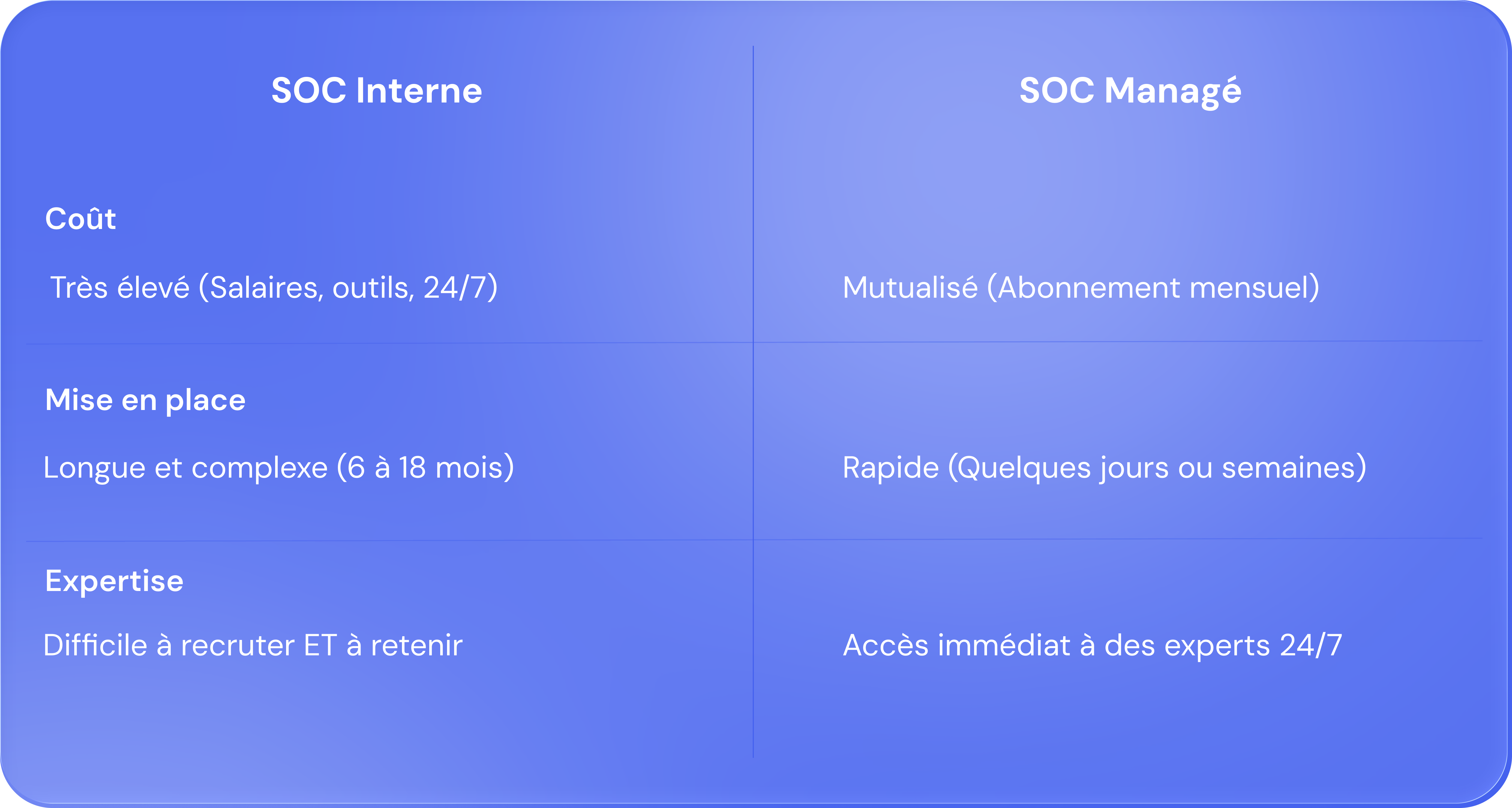
• The stratospheric cost: That is the main obstacle. Between salaries (cyber experts are very expensive), tool licenses (a SIEM can cost hundreds of thousands of euros), continuing training and premises, we are talking about a massive initial and recurring investment.
• The talent shortage: Find one good security analyst is a challenge. Finding 5 or 8 who agree to work nights and weekends is an obstacle course. And then you have to manage to keep them (they are very much in demand).
• Deployment time: You don't “launch” an internal SOC in a snap. It takes an average of 6 to 18 months to recruit, buy the tools, configure them and be truly operational.
• Alert fatigue: A small team can quickly be drowned in “false positives” (alerts that are not false positives) and miss out on the True threat.
Managed SOC: definition and operation
Faced with the complexity of the internal SOC, another solution emerged: the Managed SOC, also called external or outsourced SOC.
The idea is simple: you outsource your security surveillance to a specialized partner. Think of it as monitoring your home. You're not hiring a security guard to sit in your living room 24/7. You pay for a service that installs sensors (or uses your own) and that has a remote monitoring center with teams ready to react if the alarm sounds.
It's the same for the managed SOC: a team of analysts continuously secures your Laptops, your servers, and your cloud.

Definition of managed SOC
One Managed SOC is a “turnkey” service where a service provider (like us) takes care of the detection and response to security incidents for you.
The secret of its economic efficiency is mutualization. The service provider does not only work for you. Its analysts and tools (SIEM, EDR, etc.) monitor the fleets of dozens or hundreds of companies at the same time. You therefore have access to cutting-edge expertise and tools, for a fraction of the price of an internal SOC.
Benefits of managed SOC
• Controlled cost: That is argument number one. You are going from a heavy CAPEX investment (purchase) to a monthly, predictable and much lower OPEX (service) cost.
• Immediate and 24/7 expertise: No recruitment, no planning headaches. You have access immediately to a team of certified experts who work for you 24/7/365. •
Fast deployment: The infrastructure already exists at the provider. Integration (theOnboarding) is fast. In a few days or weeks, you are protected.
• State-of-the-art technology: The provider shalt have the best tools (SIEM, EDR, Threat Intelligence) to be effective. You benefit directly from them, without having to manage them. •
Collective intelligence (Threat Intelligence): A managed SOC sees attacks on tutti its customers. If a new threat is detected in client A, the SOC already knows how to block it at your place (client B) before it even arrives.
• The concentration: Your IT team can focus on their real work (running the business, managing projects) instead of spending their nights sorting through alerts.
Disadvantages of managed SOC
- The challenge: to find the RIGHT provider. That is the most important point. The market is full of offers, and it is vital to find a partner that goes beyond simply selling a tool. You're not just going to buy a service, you're going to entrust the security of your data to a third party. You need a team in which you have a total trust and who makes the effort to Understand your job and your specific challenges.
- The fear of “everything robotized” (and the lack of humans). Many people think “outsourced = less human.” It is a legitimate fear. Some solutions are automated “black boxes”, but when a real complex attack occurs, you want an expert on the phone, not a chatbot. That is why it is necessary to give priority to partners who guarantee access to real teams of experts, ready to analyze and intervene in real time.
- “Another partner to manage...” You already have your VPN provider, your antivirus solution, your cloud provider... Adding one more partner just for the SOC can be scary. We can already imagine the complexity. For that, don't panic, we have the solution;).
What are the criteria for choosing between internal SOC and managed SOC?
So, “homemade” or “catering”? The answer depends on 3 things: your budget, your time and the level of expertise you are able to assign.
Here are the questions to ask yourself, honestly:
- Your budget: Do you have 1 million euros to spend per year just for surveillance? If the answer is no, the choice is quickly made -> Managed SOC.
- Your speed: Do you need to be protected quickly or can you wait 12 to 18 months? If it's urgent -> Managed SOC.
- Your Talents: Do you think you have qualified experts or are you in a position to recruit a dedicated cyber team? If no -> Managed SOC.
- Your maturity: Do you already have a structured IT security team that just needs tools, or are you starting from (almost) zero? The managed SOC is ideal for maturing all at once.
- Your core business: Is 24/7 cybersecurity management your job? If you're selling furniture, software, or services, the answer is no. Focus on your business and let experts manage security.
Concrete examples of companies: which SOC model should be preferred?
Scenario 1: The SME or the ETI (100 to 1500 employees)• Background: It is growing rapidly, its data is more and more critical (customers, R&D). She uses the cloud a lot (Microsoft 365, Google Workspace). Its IT team is competent but small (2 to 5 people) and already overwhelmed.
• Best choice: Managed SOC, without a shadow of a doubt. The cost/benefit ratio is unbeatable. It is the pragmatic solution to access “large enterprise” level protection without paying the price.
Scenario 2: The very big company (CAC40, Bank, OIV)
• Background: Almost unlimited security budget. Extreme regulatory requirements. Industrial or state secrets to protect. An already large internal security team.
• Best choice: Internal SOC (or hybrid). They have the means and the need to control everything. Often, they will still rely on a managed SOC for specific tasks (threat monitoring) or to cover subsidiaries abroad.
Scenario 3: The Scale-up (50 to 300 employees, 100% tech)
• Background: 100% cloud, very agile, very tech. The IT team is made up of “devops” who want to focus on the product. Security is seen as crucial to customer trust, but not as a cost center.
• Best choice: Managed SOC. They need speed, cutting-edge expertise, and flexibility. They don't want to bother managing alerts.
Chez _Rzilient, we designed a turnkey managed SOC service which is based on what really makes a difference: dedicated human teams.
Our experts don't just push buttons. Their mission is clear:
- Prevent attacks by monitoring your vulnerabilities.
- Analyze Continuous alerts to separate noise from real threats.
- Intervene immediately in the event of a cyberattack to stop the intruder in its tracks.
We manage complexity so you can focus on your business with peace of mind.
Do you want to see what it looks like in real conditions? Learn how we deployed our managed SOC service for our client Altissima .




.webp)