
How can HR support the growth of a scale-up?
Discover our all-in-one solution

In The New Office podcast, we talk about the Future of Work, office management, employee experience and CSR. Marie Wecxsteen, Content Manager at rzilient, invites experts from a wide range of backgrounds, working in human resources, management, remote and flexible work, employee well-being, productivity, and more.
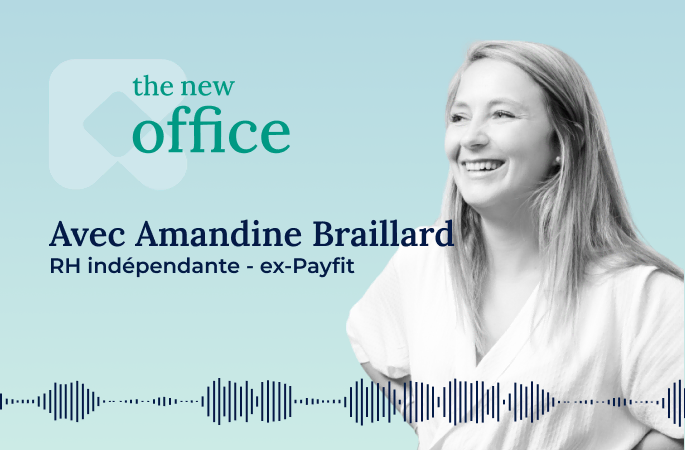
In this episode, we had the pleasure of interviewing Amandine Braillard, who was in charge of human resources at Vestiaire Collective for 5 years, before spending 6 years at PayFit. She was there during the scaling years of both startups and helped structure their HR teams. Today, she is launching Taleni, her own HR agency.
In this recap article, we share advice on how to successfully manage your onboarding processes, in order to create a successful employee experience and retain your talent.
How can HR support scaling?
Before creating her consulting business, as mentioned earlier, Amandine held HR positions in tech companies. She now offers HR consulting and support services to companies, regardless of their size.
Amandine knows the scale-up world very well. She recently left PayFit, a company she joined when the startup had 20 employees. Today, more than 1,000 people work there, with very different HR challenges. The HR team also grew significantly, from 1 to 30 people.
Amandine experienced the same kind of explosive growth at Vestiaire Collective, where the HR team grew from 1 to 10 people, and the total number of employees from 10 to 400 during her time at the company.
At the head of her own HR agency, Taleni, Amandine is driven by a strong conviction: creating a more innovative, more educational and more inspiring world of work for everyone. To reach this ideal, she draws on the lessons she learned in the field, working within teams that were growing day after day.
Responding to changes in the world of work
The Covid-19 period deeply changed traditional ways of working, pushing companies to adapt. For example, office layouts are changing to promote employee well-being. Companies also need to adapt their HR strategy to deal with greater contractual diversity, including freelancers, fixed-term contracts, permanent contracts, and more.
On top of these changes comes the contractual diversity of work. Part-time work, the 4-day week, mobility, remote work and other changes all generate new developments.
Employee engagement is another key topic. As you probably know, an employee does not stay at a company forever.
Companies need to accept these changes in order to energize their HR function and improve the working environment.
Making employees want to work is no longer only about salary, but also about the working environment, personal fulfillment and professional development.
As Amandine Braillard explains: “you need to create positive employee experiences to generate engagement.”
And to achieve this, you need to make onboarding a real success.
Employee retention: the importance of onboarding
A company that fails an employee’s onboarding fails their integration.
And if integration is not successful, the employee may leave the company. Everything then has to start again, from recruitment and job interviews to the new hire’s arrival and training.
By failing an onboarding process, your company loses valuable time. There are also financial stakes that should not be overlooked. According to a 2017 report by consulting firm Mozart Consulting, a failed integration can generate costs of €5,000, or even €10,000, per employee.
Poor onboarding can also affect your employer brand, as an employee who did not stay with your company may share negative feedback about it online and within their network.
There are also internal consequences. A lack of workforce in your teams increases the workload of remaining employees and can also lead to higher turnover. In the long term, the social climate within the company may deteriorate due to stress.
So, how can you take action? Empathy and preparation are the keys to quality onboarding.
As Amandine Braillard clearly says during her interview with Marie: “You need to develop this empathy and ask yourself: how can I offer the best and smoothest possible experience to my new employee?”
People must be at the heart of the process. Everything depends on creating a connection and supporting the new employee from start to finish.
You can apply these few tips from Amandine Braillard to make your onboarding processes successful:
- Before the employee arrives: after the contract has been signed, do not leave your future employee without any news. Send them an email once a month, for example, to build engagement. You can also invite them to meet their manager and their team.
- Before the probation period: you can automate and simplify the part related to tools by preparing the equipment your new employee will need in advance. At rzilient, for example, we simplify onboarding by offering suitable equipment that you can choose, preconfigure and deliver to the postal address and date of your choice. Also allow your new employee to discover your company in detail, including its departments, its origin story, its culture, its values, and more, before they start in their role.
- During the probation period: continue building connections through check-ins, meetings and other activities, to make sure your new employee feels good and remains motivated. Use this opportunity to determine whether there is anything you can do to improve their day-to-day work experience.
You will find information on administrative, IT and equipment preparation to achieve successful onboarding in our ebook: Onboarding: welcome your new employees without forgetting anything!
.webp)
How can you measure the effectiveness of the actions carried out by an HR team?
In a small company, it is easy to measure the effectiveness of onboarding by speaking directly with employees.
In a large company, however, HR teams cannot talk individually with every employee to find out whether they feel good and happy at work.
What Amandine recommends to measure the effectiveness of HR actions is using eNPS tools, meaning Employee Net Promoter Score tools, which help identify the topics that need to be worked on.
Measuring employees’ emotional state is another important action. The best way to achieve this is to build a business partner culture. Work with other members of your company to understand how your colleagues are feeling. For example, you can organize regular interviews with managers.
The “walk in my shoes” principle also allows you to better understand your employees’ emotional state. Follow your employees, observe what they do on a daily basis, put yourself in their shoes and try to understand the challenges of their work, in order to better grasp their emotional dimension.