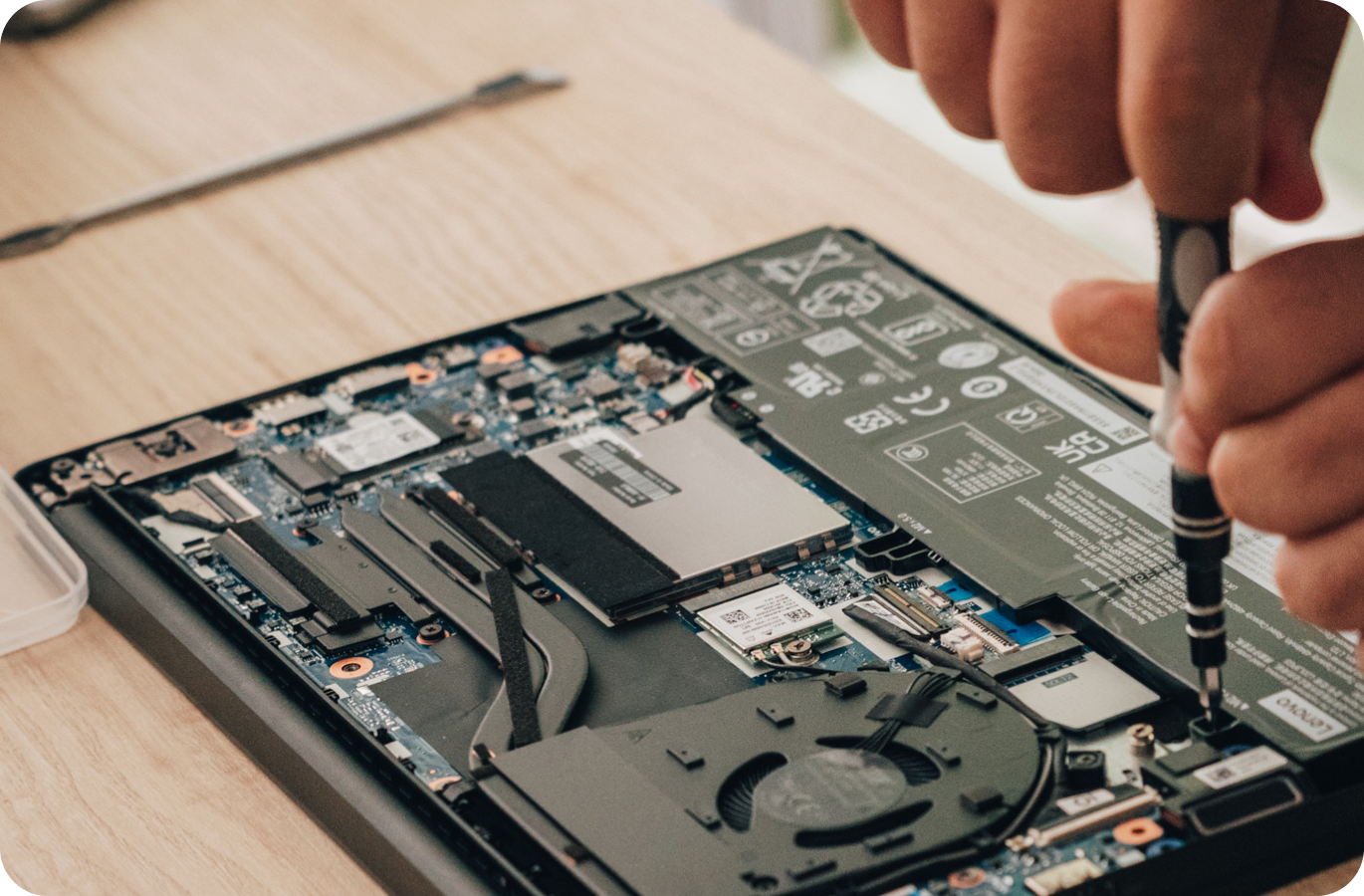
The challenges of managing computer hardware
.webp)
Benefit from effective IT support
Discover our all-in-one solution

Les challenges in Term of computer hardware management are no longer just “buying computers and managing a stock closet.” With the spread of hybrid work, teams distributed remotely, the increase in the requirements of data security and the pressure on resources, The computer park became an eminently strategic subject. It has a direct impact on the employee experience, operational continuity... and your overall risk level.
In other words: if the management of corporate IT equipment is approximate, the entire organization ends up paying for it. A computer that does not arrive on time = a slow start for a new recruit. A workstation that is not updated = a risk of critical failure. Equipment not recovered during a departure = potentially exposed data and an unnecessary purchase. And when IT teams spend their time putting out fires, they no longer make progress on the real issues: reliability, cybersecurity, optimization and support for teams.
Good news: these challenges are well known, and above all controllable. As long as you stop managing “by hand” and adopt a more structured approach: reliable inventory, workflows, automations and monitoring of lifecycle IT assets.
IT hardware management is becoming more and more complex
What makes IT asset management difficult today is not a single problem: it is the piling up of constraints that are often contradictory:
- More mobility : equip, dispatch, pick up and troubleshoot remote employees (including internationally).
- More security & compliance requirements : maintaining a reliable inventory, guaranteeing traceability, encryption, access management and data deletion.
- No more budget pressure : avoid over-equipment, reduce losses and extend the life of equipment... without taking risks.
- More expectations on the HR/Ops side : offer “frictionless” arrivals, controlled departures, and fluid processes without depending on an army of administrators.
Added to this is the environment: the manufacture of equipment is heavy. Extending the life of the equipment fleet is becoming a performance logic (and not just a CSR subject).
What does all this have in common? Without a monitoring and management tool, the management of infrastructure and resources becomes a lottery: too many gray areas, too many exceptions, too much time lost. On the other hand, with centralized control and automations, you can gain in efficiency, security and visibility, without burdening processes.
.webp)
The 5 challenges associated with IT hardware management
1) Cost management: between investment and optimization
The first challenge is pragmatic: paying the right price for the right level of service.
Visible costs (purchase, maintenance, services) are easy to track. The invisible costs, on the other hand, often weigh much more: underused equipment, emergency purchases, losses/thefts, too frequent renewals “for safety”, or equipment that is dormant because they have not been reallocated.
What works in practice is to control each piece of equipment by lifecycle (entry → use → maintenance → end of life) to decide on facts, not on intuition. The objective is not necessarily to “pay less”, but to be more flexible and to avoid avoidable expenses (support, emergency, losses, overequipment).
To help you decide on the economic model best suited to your reality (budget, growth, flexibility, renewal), consult our article on the subject: choosing between leasing and buying IT equipment.
2) The availability of equipment: responding quickly to the needs of employees
An employee waiting for his computer wastes time... and so does the company. Here, the challenge is not to pile up inventory: it's to have the right orchestration.
You need to be able to:
- know exactly who has what equipment (and where it is located),
- prepare ready-to-use workstations (configuration + security),
- deliver quickly, even remotely,
- manage returns without data loss, then put back into circulation without friction.
The biggest pitfall is improvisation: each arrival becomes a “logistical mini-project”, and each emergency causes deadlines to explode. On the other hand, a clear process turns it into a routine.
That is exactly the role of a good process of IT onboarding : limit improvisation and offer a fluid experience from day one. And on the departure side, a IT offboarding Rigorous allows you to quickly revoke access, recover equipment, erase data, and reassign it without creating gray areas.
3) Control logistics and stocks: traceability and optimization of flows
When you add sites, service providers, repairs, teleworking and replacements, your equipment fleet becomes a real supply chain.
Without a reliable tool, you experience:
- “phantom” material (not found, not attributed, misdeclared),
- “just in case” purchases that increase the budget,
- deadlines that explode in the event of an incident,
- major security risks (workstation not recovered, not deleted, non-compliant).
The foundation of healthy logistics is based on up-to-date inventory, clear traceability and simple statuses (assigned, in stock, in transit, in repair, at the end of life). In short: a single database that avoids double entries, oversights and discrepancies between “what you think you have” and “what you really have”.
Structuring is the top priority the Inventory of computer equipment.
4) Anticipating future needs: how to manage the evolution of IT hardware in a growing company?
When a company grows, the real risk is that hardware and IT processes will hinder growth: bottlenecks, saturated support, heterogeneity of equipment, and security debt that accumulates.
To avoid this and scale calmly, keep your reflexes simple:
- standardize without rigidifying (a base of bearable equipment, without blocking specific cases),
- monitor the compliance status of posts (updates, encryption, security posture),
- use HRIS connectors (HR Information System) so that information flows automatically between IT, HR and operations (arrivals, departures, role changes).
The goal: a scalable infrastructure, even when distance becomes the norm, and even when recruitment volumes accelerate.
5) Responding to environmental challenges: eco-responsible management of IT equipment
Extend the life of computer hardware (without creating security debt) has become a strategic lever.
In concrete terms, more responsible management involves:
- one life extension strategy (when it is secure),
- The use of refurbished equipment,
- The revalorization at the end of life,
- Of robust data return and deletion processes.
The key point: sustainability and safety must move forward together. Keeping equipment longer only makes sense if you precisely control its condition, vulnerabilities, and compliance level.
And that's exactly where rilient DNA comes into its own: centralize inventory, Automate critical moments (arrivals, departures, renewals), secure end-to-end, and integrate a Green IT logic (second life, revalorization) with human support when you have to go quickly, without friction.
.webp)
.webp)
.webp)